
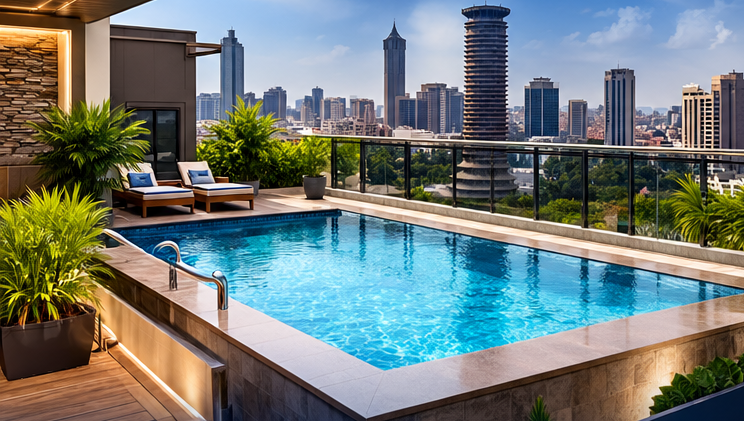
Setting up a swimming pool in Nairobi’s rapidly changing real estate scene involves some particular structural and logistical challenges. Whether the plot is small and confined, as in Westlands and Kilimani or much larger and with clay composition, as witnessed in Karen and Runda, building a pool requires accurate structural engineering, sophisticated waterproofing, and energy-efficient climate control. Aquapools designs and builds luxury residential, rooftop, and commercial swimming pools in Nairobi with the aim of ensuring they are long-lasting, have low running costs, and integrate smoothly with the architecture.
Navigating Nairobi’s Diverse Soil Topography and Urban Constraints
Nairobi’s geological composition varies significantly across its urban zones. High-plasticity black cotton soil—which encounters a rapid volume expansion when saturated, and deep shrinkage during dry periods—dominates the eastern and southern plains. Conversely, western suburbs such as Karen, Lavington, and parts of Lang’ata feature stable, deep red volcanic soils. Areas like Upper Hill and Parklands generally sit on shallow volcanic rock formations (such as Nairobi Trachyte or Kerichwa Valley Tuffs), allowing foundations to anchor directly into competent bedrock via pad footings or raft slabs
Aquapools resolves these site-specific challenges through targeted structural engineering:
In areas with high-shrinkage clay, trenches are dug below the reactive soil layer, and the site is then backfilled with compacted quarry dust, hardcore, and blinding concrete to create a stable layer which acts as a cushion and separates the pool shell from any movement of the ground.
The engineering of elevated and rooftop pools relies on reinforced concrete columns and support slabs designed to manage heavy hydrostatic loads. To isolate structural movements and prevent unmitigated stress transfer to the primary building frame, engineers perform precise calculations for weight distribution, dynamic sloshing loads, and redundant double-containment systems.
Optimising the compact footprint: the zero-edge, plunge pool, and swim-jet arrangements enable high-end private residences to make the most of small backyards without compromising luxury or swimmer movement.
Advanced Structural Concrete and Multi-Layer Waterproofing
The high density of Nairobi’s urban areas leaves no room for structural leaks; if a pool leaks on the roof or close to a property boundary, it can damage the building’s foundations and cause serious structural harm. When Aquapools carry out a construction project, it applies strict waterproofing procedures.
The concrete is poured in one piece, and the structural shells are made using high-density concrete mixes containing crystalline waterproofing agents. These crystalline substances react chemically with moisture to form micro-crystals that permanently seal the capillaries in the concrete matrix.
Before tiling, a dual-layer application of flexible, fibre-reinforced elastomeric waterproofing mortar is carried out on the inner shell and the cold construction joints are sealed using continuous neoprene or hydrophilic rubber waterstops.
When installing the tiles with precision, waterproof epoxy adhesives are used to lay the glass mosaic tiles and the dark slate pool copings, thus avoiding joint deterioration or tile detachment over time.
Smart Hydraulics, Water Conservation, and Heating Technologies
The cool nights and changing weather in Nairobi mean that it is essential to have good temperature control and energy efficiency if the pool is to be used all year round. Aquapools has incorporated modern hydraulic automation and climate control systems:
Air-source inverter heat pumps are fitted directly into the return lines and provide a consistent water temperature between 28°C and 30°C at only a small fraction of the energy cost of ordinary electric heaters.
Commercial and large residential pools make use of thermal solar panels mounted on the roof, which are connected to automatic diversion valves so that they can take priority and make use of free solar energy whenever sunlight is available.
Pumps fitted with variable-frequency drives work at reduced speeds when carrying out normal daily filtration and only increase their speed during backwashing, thereby reducing their electrical power consumption by as much as 70%.
Standard sand filters are improved by using recycled glass media, which is able to capture particles as small as 5 microns, prevents the development of bacterial biofilm, and reduces the amount of water wasted during backwashing by half.